
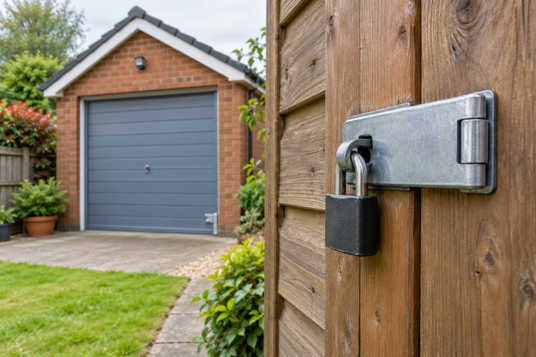
When thinking about home security, most people focus on their front and back doors. Garages and garden sheds can be overlooked, even though they often hold tools, bicycles, gardening equipment and other valuable belongings.
Autumn is a good time to check these spaces. Shorter evenings can make outside storage areas less visible from the house, while doors and hardware may have been exposed to months of rain, dust and everyday use.
A secure outbuilding needs more than a padlock that looks substantial. The door, frame, fittings and locking points all need to work together.
Start by checking the condition of the door
A strong lock offers limited protection if it is attached to a rotten wooden panel, a weak hasp or a loose frame. Check for damaged timber, rusted fixings, gaps around the edges and any signs that the door has dropped or twisted.
For a shed, pay attention to exposed hinge screws and lightweight fittings. On a garage, look at the overall condition of the door and whether it closes fully without needing to be forced.
Choose locks that suit the door
Different outbuildings need different locking solutions. A timber shed may use a suitable closed-shackle padlock with a robust hasp and staple, while other doors may benefit from a correctly fitted mortice lock or additional bolts.
Garage doors vary considerably. Up-and-over, side-hinged and pedestrian access doors do not all use the same mechanisms. Some may accept extra security devices, but any upgrade must be compatible with the door and must not interfere with safe operation.
Check the quality of padlocks and fittings
A padlock is only as useful as the hardware holding it. If the hasp can be unscrewed easily from outside, the lock may offer little practical protection. Look for appropriately rated hardware and strong, correctly fitted fixings.
Where suitable, a closed-shackle design can reduce exposure of the shackle. However, the right choice depends on the door, fittings and how the building is used. RJ Parker Locksmiths stocks a range of padlocks and associated security hardware, including open- and closed-shackle options, locking bars, ground anchors and chains.
Do not forget garage side doors and connecting doors
A side door to the garage can become the weak point if it has an older or poorly maintained lock. If the garage connects directly to the house, the connecting door deserves particular attention because it forms part of your home’s security.
Check that locks engage properly and that the door and frame are sound. If you are unsure what standard of security is appropriate, ask your insurer about any relevant conditions and speak to a locksmith about suitable options.
Think about hinges, windows and visibility
Accessible hinges, flimsy window fittings and poor lighting can make an otherwise solid building vulnerable. Consider whether windows can be secured appropriately, whether outside lighting would help and whether expensive contents are plainly visible from the garden or street.
Security improvements do not have to be complicated. Removing obvious weaknesses and making sure everything closes properly can be a valuable first step.
Keep keys and access arrangements under control
Avoid leaving shed or garage keys in obvious outdoor hiding places. If several people use the building, know who has a key and avoid creating unnecessary copies. After moving house or losing a key, it may be worth reviewing who can access these spaces.
If an old lock is unreliable or nobody knows how many keys exist, changing it can be more useful than continuing to rely on it. A locksmith can advise on replacement locks and additional bolts suited to the door.
Check your insurance rather than making assumptions
Home insurance policies differ in how they treat garages, sheds and their contents. Some specify security requirements, have separate limits for outbuildings or exclude particular items unless conditions are met.
Read the policy wording and speak to your insurer if you are unsure. Installing a better lock is a sensible security measure, but it does not automatically guarantee that every item will be covered.
When should you call a locksmith?
Consider professional help if a garage lock is stiff, a key repeatedly jams, a door no longer closes properly or the existing fittings appear damaged. A locksmith can check whether the problem is with the cylinder, locking mechanism, fittings or alignment and recommend a proportionate solution.
RJ Parker Locksmiths supplies and works with a wide range of door locks, including garage door locks, padlocks, replacement locks and bolts. If you would like advice on improving an outbuilding’s security in Coventry or nearby areas, call 02476 594171 or contact RJ Parker Locksmiths.